|
Overview and Introduction - Schizophrenia and Paranoid Schizophrenia
There is a lot of information here - so please be sure to scroll all
the way down to the bottom.
Introductory Tips for Family Members of People with Schizophrenia
Types of Schizophrenia and Related Illnesses
Paranoid schizophrenia is the most common form of schizophrenia - and
is especially common in younger males.
- Types of Schizophrenia
- Paranoid schizophrenia
- These persons are very suspicious of others and often have grand
schemes of persecution at the root of their behavior. Halluciations,
and more frequently delusions, are a prominent and common part of
the illness.
- Disorganized
schizophrenia (Hebephrenic Schizophrenia) - In this case the
person is verbally incoherent and may have moods and emotions that
are not appropriate to the situation. Hallucinations are not usually
present.
- Catatonic
schizophrenia - In this case, the person is extremely withdrawn,
negative and isolated, and has marked psychomotor disturbances.
- Residual
schizophrenia - In this case the person is not currently suffering
from delusions, hallucinations, or disorganized speech and behavior,
but lacks motivation and interest in day-to-day living.
- Schizoaffective
disorder - These people have symptoms of schizophrenia as well
as mood disorder such as major depression, bipolar mania, or mixed
mania.
- Undifferentiated
Schizophrenia - Conditions meeting the general diagnostic criteria
for schizophrenia but not conforming to any of the above subtypes,
or exhibiting the features of more than one of them without a clear
predominance of a particular set of diagnostic characteristics.
- Additional Information on Schizophrenia
- Schizoid Personality
- Schizophreniform
Disorder
- Schizotypal
Personality
- Bipolar Disorder
(Manic Depression) - frequently misdiagnosed as schizophrenia (and
vise versa)
- Asperger's
Syndrome - a type of Autism that may be misdiagnosed as schizophrenia
in children
The Value and Importance of Early Treatment in Schizophrenia -
Sadly, a very common misconception in families of people with schizophrenia
is the though that "if we do nothing, maybe it will get better -
maybe its just
a phase." The truth is, however, that this is typically the worse
thing that can be done if the person does have schizophrenia, and greatly
increases the probablity that the person will suffer much more permanent
damage than if treated quickly. Schizophrenia is generally recognized
now as a disease of the brain (with significant data that supports the
belief that it is a neurodevelopment problem in the brain) in which the
brain is physically damaged (see images
of brain with schizophrenia), and unfortunately the noticable symptoms
of schizophrenia are usually quite late in the disease process.
Dr. Herbert Y. Meltzer, a professor of psychiatry at Vanderbilt University
and an expert on schizophrenia, has said, "the psychosis part of
schizophrenia is almost a late stage in the evolution of the disease
process." and that, "the key message is that this is a neurodevelopmental
disorder and that changes in memory, learning, attention and executive
decision-making precede the experience of the psychosis."
Individuals who are at risk for developing a psychotic illness usually
experience mental and emotional changes before more serious symptoms
develop. These early signs are often non-specific, sometimes, even barely
noticeable. The unexpected decline in a person's usual way of functioning
or relating to others is the most common indicator of an early sign
of risk. This early period is called the "prodromal" period
(or Prodrome) by psychiatrists.
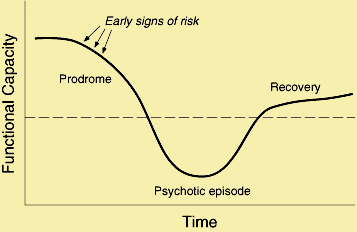
If any of the early signs of risk are present, it is important to seek
help quickly in order to ensure the greatest chance for recovery. By
identifying and treating the early signs of risk, it is hoped that a
psychotic episode might be delayed, prevented, or reduced in intensity.
Added to the predisposition towards delays in getting treatment is the
fact that as many as 50% of people with schizophrenia can't understand
that they are ill (because the part
of the brain affected by schizophrenia is frequently the same part
that is responsible for self-analysis) and you have a situation where
most people with schizophrenia have a much worse outcome than what is
possible given today's treatment options. See Also: Preventing
Schizophrenia
- What if the Person is Too Sick to Understand they have Schizophrenia?
- Examples of Early Intervention Programs around the World (Canada and
Australia are the leaders in Early Schizophrenia Treatment Programs)
Differences in How Schizophrenia Impacts Men
and Women
There are many ways in which schizophrenia affects men and women differently.
For example, some of the well known facts are that schizophrenia tends
to begin in men/boys at an earlier age than women/girls; men who have
schizophrenia generally begin showing signs of the illness between ages
15 and 20, compared to ages 20 to 25 for women. Additionally, men overall
are less responsive to medication and schizophrenia also tends to have
a larger impact on men than on women - the long term outcome tends to
be worse for men than women. Researchers have hypothesized that estrogen
may play a protective role in women against schizophrenia.
Recent research also tends to suggest that schizophrenia is more prevalent
in men than women - with women developing schizophrenia at a rate of
approximately 50% to 75% that of men, overall. Women, however, have
a rate of developing schizophrenia almost twice that of men for people
over the age of 45 years. Again, a protective effect of estrogen may
be involved here, researchers suggest. Following are some stories and
resources on the differences of schizophrenia's impact in men and women.
As this is a relatively new area of research, we'll be adding more information
here in the future.
Why Schizophrenia Impacts Men harder
than Women?
Book: (Scientific Book): Women
and Schizophrenia , Edited by David J. Castle, John McGrath and
Jayashri Kukarni, 151 pages ; Publisher: Cambridge University Press;
1st edition (September 15, 2000) , ISBN: 0521786177
Recommended Books on Schizophrenia - for people new to the disease
Dr. E. Fuller Torrey's book "Surviving Schizophrenia" is
an book we highly recommend for every family affected by schizophrenia.
Dr. Torrey is a leader in the schizophrenia research field, has worked
in many hospitals with people who have schizophrenia and Dr. Torrey
has a sister with schizophrenia, so in writting this book he has drawn
from extensive personal, clinical and research experience. For a good
news story on Dr. Torrey please see: "Schizophrenia's
Most Zealous Foe".
"Diagnosis Schizophrenia" is also an extremely good book
that has been written with the direct input from a lot of people who
have schizophrenia who discuss their personal experiences. It is valuable
for all family members to read, as well as for the person who has schizophrenia.
"I'm Not Sick..." is another good book for people to read
if they have a family member or friend who does not understand they
have schizophrenia and don't think they need help. Lastly, "Schizophrenia
Revealed" has also gotten many good reviews.
Surviving
Schizophrenia: A Manual for Families, Consumers, and Providers (4th
Edition) by E. Fuller Torrey (Author), Publisher: Quill; 4th edition
(May 8, 2001) ISBN: 0060959193
Diagnosis:
Schizophrenia by Rachel Miller (Editor), Susan Elizabeth Mason (Editor),
Publisher: Columbia University Press; (October 15, 2002) ISBN: 0231126255
I
am Not Sick, I Don't Need Help! - Helping the Seriously Mentally Ill
Accept Treatment by Xavier Amador, Anna-Lica Johanson (Contributor),
Publisher: Vida Press; (June 2000) ISBN: 0967718902 - This book helps
you learn what the latest research says about why so many do not believe
they are ill, why they refuse treatment, and how you can help. The book
is written for families and therapists. This book is also available
in Spanish (see directly below)
No Estoy Enfermo!
No Necesito Ayuda! by Dr. Xavier Amador, with Anna-Lisa Johanson
Recommended Books on Day-to-Day Coping Strategies
for Families
After a family has learned the basics about schizophrenia in the "Introductory"
books above, we recommend the following books be read for ideas and
suggestions on how to deal with the many unique, day-to-day challenges
that you'll face when trying to help and live with a mentally ill person.
"Adamec, herself the mother of a schizophrenic daughter, presents
a handbook for developing daily coping and caregiving skills. Not intended
to describe, diagnose, or treat any particular mental illness, this
book instead advises the caregiver on how to balance the needs of the
family as a whole and suggests strategies for dealing effectively with
common and serious symptoms (e.g., hallucinations, poor hygiene) and
situations (e.g., refusals to take medication, disagreements between
the caregiver and doctors or therapists).
Surviving
Mental Illness: Stress, Coping, and Adaptation by Agnes B. Hatfield,
Harriet P. Lefley, John S. Strauss, Publisher: Guilford Press; (May
21, 1993) ISBN: 0898620228
Other very good books in this area:
How
to Live With a Mentally Ill Person: A Handbook of Day-To-Day Strategies
by Christine Adamec, D. J. Jaffe, Publisher: John Wiley & Sons; (April
1996) ASIN: 0471114197
When
Someone You Love Has a Mental Illness: A Handbook for Family, Friends,
and Caregivers, by Rebecca Woolis, Agnes Hatfied, Publisher: J.
P. Tarcher; (September 1992) ISBN: 0874776953
Overcoming
Depression, 3rd edition by Demitri Papolos, Publisher: Quill; 3rd
edition (February 1997), ISBN: 0060927828
For more reading materials - we recommend you review our entire
list of recommended books and videos.
Additional Important Educational Information on Schizophrenia
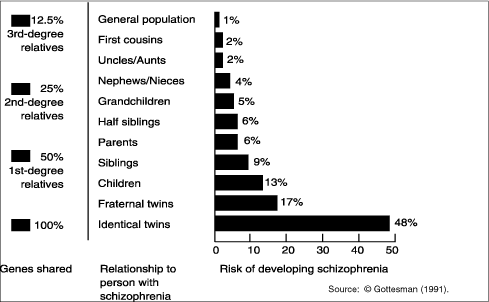
The Risks of Getting Schizophrenia
How the Experts recommend that Schizophrenia is Treated
Popular Press News Stories on Schizophrenia
s
|
|



 Early Schizophrenia Diagnosis and Treatment Centers

